
|
Aluminum
and its alloys can be joined by more methods
than any other metal, but aluminum has several
chemical and physical properties that need to be
understood when using the various joining
processes.
The specific properties that affect welding
are its oxide characteristics, its thermal,
electrical, and nonmagnetic characteristics,
lack of color change when heated, and wide range
of mechanical properties and melting
temperatures that result from alloying with
other metals.
Oxide. Aluminum oxide melts at about
2050 oC which is much higher than the
melting point of the base alloy. If the oxide is
not removed or displaced, the result is
incomplete fusion. In some joining processes,
chlorides and fluorides are used in order to
remove the oxide contain. Chlorides and
fluorides must be removed after the joining
operation to avoid a possible corrosion problem
in service.
Hydrogen Solubility. Hydrogen
dissolves very rapidly in molten aluminum.
However, hydrogen has almost no solubility in
solid aluminum and it has been determined to be
the primary cause of porosity in aluminum welds.
High temperatures of the weld pool allow a large
amount of hydrogen to be absorbed, and as the
pool solidifies, the solubility of hydrogen is
greatly reduced. Hydrogen that exceeds the
effective solubility limit forms gas porosity,
if it does not escape from the solidifying weld.
Electrical Conductivity. For arc
welding, it is important that aluminum alloys
possess high electrical conductivity -- pure
aluminum has 62% that of pure copper. High
electrical conductivity permits the use of long
contact tubes guns, because resistance heating
of the electrode does not occur, as is
experienced with ferrous electrodes.
Thermal Characteristics. The thermal
conductivity of aluminum is about 6 times that
of steel. Although the melting temperature of
aluminum alloys is substantially bellow that of
ferrous alloys, higher heat inputs are required
to weld aluminum because of its high specific
heat.
High thermal conductivity makes aluminum very
sensitive to fluctuations in heat input by the
welding process.
Forms of Aluminum. Most forms of
aluminum can be welded. All the wrought forms
(sheet, plate, extrusions, forgings, rod, bar
and impact extrusions), as well as sand and
permanent mold castings, can be welded. Welding
on conventional die-castings produces excessive
porosity in both the weld and the base metal
adjacent to the weld because of internal gas.
Vacuum die-castings, however, have been welded
with excellent results. Powder metallurgy (P/M)
parts also may suffer from porosity during
welding because of internal gas.
The alloy composition is a much more significant
factor than the form in determining the
weldability of an aluminum alloy.
Filler Alloy
Selection Criteria
When choosing the
optimum filler alloy, the application (end use)
of the welded part and its desired performance
must be prime considerations. Many alloys and
alloy combinations can be joined using any one
of several filler alloys, but only one filler
may be optimal for a specific application.
The primary factors commonly considered when
selecting a welding filler alloy are:
- Ease of welding
- Tensile or shear strength of the
weld
- Weld ductility
- Service temperature
- Corrosion resistance
- Color match between the weld and the
base alloy after anodizing
- Sensitivity to Weld Cracking.
Ease of welding is the first consideration
for most welding applications. In general, the
non-heat-treatable aluminum alloys can be welded
with a filler alloy of the same basic
composition as the base alloy.
The heat-treatable aluminum alloys are
somewhat more metallurgical complex and
more sensitive to "hot short" cracking,
which results from heat - affected zone
(HAZ) liquidation during the welding
operation. Generally, a dissimilar alloy
filler having higher levels of solute (for
example, copper or silicon) is used in this
case.
- The high-purity 1xxx series alloys
and 3003 are easy to weld with a base
alloy filler, 1100 alloy, or an aluminum
- silicon alloy filler, such as 4043.
- Alloy 2219 exhibits the best
weldability of the 2xxx series base
alloys and is easily welded with 2319,
4043 and 4145 fillers.
- Aluminum-silicon-copper filler alloy
4145 provides the least susceptibility
to weld cracking with 2xxx series
wrought copper bearing alloys, as well
as aluminum-copper and
aluminum-silicon-copper aluminum alloy
castings
- The cracking of aluminum-magnesium
alloy welds decreases as the magnesium
content of the weld increases above 2%.
- The 6xxx series base alloys are most
easily welded with the aluminum-silicon
type filler alloys, such as 4043 and
4047. However, the aluminum-magnesium
type filler alloys can also be employed
satisfactorily with the low-copper
bearing 6xxx alloys when higher shear
strength and weld metal ductility are
required.
- The 7xxx series
(aluminum-zinc-magnesium) alloys exhibit
a wide range of crack sensitivity during
the welding. Alloys 7005 and 7039, with
a low copper content (<0.1%), have a
narrow melting range and can be readily
joined with the high magnesium filler
alloys 5356, 5183 and 5556. The 7xxx
series alloys that possess a substantial
amount of copper, such as 7975 and 7178,
have a very wide melting range with a
low solidus temperature and are
extremely sensitive to weld cracking
when are welded.
Welding
Processes
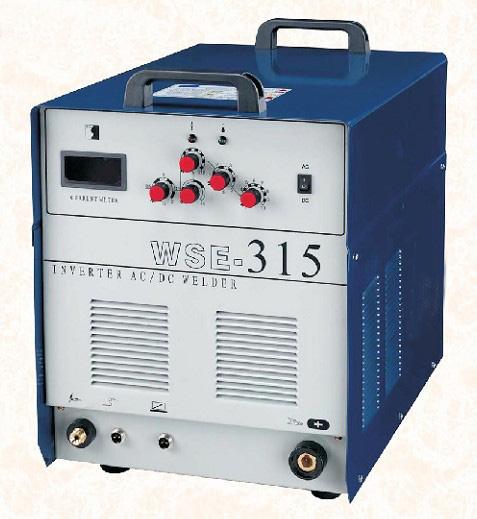
The GTAW
(gas-metal arc welding) process has been used to
weld thicknesses from 0,25 to 150 mm and can be
used in all welding positions. Because it is
relatively slow, it is highly maneuverable for
welding tubing, piping and variable shapes. It
permits excellent penetration control and can
produce welds of excellent soundness. Weld
termination craters can be filled easily as the
current is tapered down by a foot pedal or
electronic control.
The ac - GTAW process provides an arc
cleaning action to remove the surface oxide
during the positive electrode half of the cycle
and a penetrating arc when the electrode is
operated at negative polarity.
The dc - GTAW Process. Negative electrode
polarity direct current can be used to weld
aluminum by manual and mechanized means.
Other arc welding processes include
shielded metal arc welding (SMAW), as well as
electroslag and electrogas welding (ESW, EGW).
SMAW with flux-coated rods has been replaced to
a very substantial degree by the GMAW process.
The oxyfuel gas welding (OFW) process
uses a flux and either an oxyacetylene or
oxyhydrogen gas flame. When the oxyacetylene
flame is used, a slightly reduced flame is
required, which causes a carbonaceous deposit
that obscures the weld and slows the travel
speed.
Electron - beam welding (EBW) in a vacuum
chamber produces a very deep, narrow penetration
at high welding speeds. The low overall heat
input produces the highest as-welded strengths
in the heat treatable alloys. The high thermal
gradient from the weld into the base metal
creates very limited metallurgical modifications
and is least likely to cause intergranular
cracking in butt joints when no filler is added.
Laser-beam welding (LBW) is now
considered to be a viable fusion joining process
for aluminum with the advent of commercially
available, stable, high-power laser systems.
Because of aluminum`s high reflectivity,
effective coupling of the laser beam and
aluminum requires a relatively high power
density.
List of Articles -
Knowledge Base |
|
|

